Answers to Legal and Human Resource FAQs are provided with assistance of nationally recognized legal expert on industrial safety Adele L. Abrams, Esq., Associate Safety Professional (ASP), Certified Mine Safety Professional (CMSP), whose law firm (www.safety-law.com) focuses on safety, health, and employment law nationwide.
14) Has DRUID’s accuracy been scientifically peer-reviewed?
Yes, DRUID has three independent, peer-reviewed, published, scientific studies. You can access them here: https://www.impairmentscience.com/peer-reviewed-studies
15) Will DRUID hold up in court?
DRUID is not currently meant to be introduced as evidence in court. DRUID is a general, non-specific test for impairment, detecting and measuring impairment from any source, including:
• Cannabis
• Illicit substances
• Prescription and over-the-counter medications
• Alcohol
• Fatigue
• Acute illness
• Injury (including concussion)
• Chronic medical conditions
• Severe stress, and
• Environmental factors (extreme heat, cold, or altitude)
Importantly, DRUID identifies that there is impairment, not its cause. Because DRUID is a general test of impairment, employers cannot know whether a significantly elevated DRUID test score is due to any specific cause. An elevated DRUID score could be caused by fatigue, drugs, or any other cause, including those listed above. Thus, taking disciplinary action based on the DRUID test alone is not advised. Analogously, a physician would be unlikely to prescribe a treatment or medication to a patient based on a fever thermometer reading alone without taking into account other observations and, perhaps, other tests.
We counsel our customers that if they are going to take disciplinary action against an employee, they base their action, not only on DRUID, which brought the problem to their attention in the first place, but also on other evidence provided by an observational safety assessment, tests other than DRUID (including a drug test, if appropriate).
The innovative benefit of DRUID is that it allows employers, for the first time, to objectively identify who is likely to be impaired and to quantify how impaired they might be. In this way, DRUID serves as an intelligent trigger for the employer’s next set of actions.
Those next actions, subjecting the employee to further scrutiny, would be based on the DRUID score, which is an objective measure. No longer would the decision to take further action be based on a supervisor’s subjective assessment alone. Basing further scrutiny on an objective measure, like DRUID, relieves supervisors of the burden and imprecision of making such judgments, while at the same time helping to relieve employees of their suspicion that, subject to supervisors’ biases, they are being unfairly treated. As a tool meant to identify potential safety risks, DRUID substitutes its scientific reach, accuracy, and objectivity for a supervisor’s all-to-human subjectivity.
In other words, DRUID is not a standalone substitute for drug testing. DRUID is complementary to conventional drug testing, enlarging the effort to prevent accidents from all causes of impairment.
Employers can rely on DRUID to set in motion appropriate steps to identify individuals who may, ultimately, be subject to discipline. But it is the evidence produced by these subsequent steps – drug tests, observations, medical review, and the like – not the DRUID test scores by themselves that would be presented as evidence in a legal proceeding.
16) What is the reaction to DRUID from unions?
Initially, unions tend to see any employee testing as invasive, stigmatizing, and punitive.
The key to union acceptance of impairment testing is education. Unions are receptive once they understand that DRUID is NOT a drug test and is not stigmatizing (because an elevated score does not necessarily indicate drug use and could be due to any cause of impairment). DRUID’s objective, quantitative measurement helps mitigate the subjectivity of impairment assessments made by supervisors. It contributes to re-aligning the employer-employee relationship away from punishment toward mutual concern for the employee’s well-being. It promotes problem-solving, rather than mere disciplinary measures, and in that way promotes employee retention. Because the focus is on fit for duty, employees, particularly those in safety-sensitive jobs requiring worker collaboration, are comforted that with impairment testing they are at less risk from the impairment of their co-workers. In short, impairment testing is to the benefit, not detriment, of the union employee.
The United Electric Workers union has stated that: “The union should bargain for language that says what is unacceptable is on the job impairment. We want testing that shows on the job usage [of drugs] or impairment, not off the job usage… we want language that says that rehabilitation is primary, not punishment.” (Original emphasis) (https://www.ueunion.org/stwd_drugalcohol.html)
DRUID’s very first licensee was a large unionized, underground palladium mine in Ontario. When Canada legalized cannabis, this mine’s management wished to increase drug testing. The union was strongly opposed. Management then found DRUID as a complementary solution. The union, based on the reasons above, agreed to go forward. Miners were then assessed with DRUID both at the start and the end of work shifts. End-of-work shift testing was specifically to assess fatigue, both in individuals and by work shift group. DRUID usage was so successful that mine management, on their initiative, developed a user case study and presented it to their provincial mining association.
(See, https://www.impairmentscience.com/post/assessing-impairment-of-shift-workers-at-underground-mine)
17) Is the data collected by DRUID considered personal health information governed by HIPAA?
The use by DRUID of facial recognition, finger ID, or any of the other data it collects is not a HIPAA violation. Biometrics, like these, are considered protected health information (PHI) only when connected to a patient’s health records or used within healthcare services. DRUID is not a medical device, is not connected to health records, or is used within healthcare services, and thus, like many other wellness apps, is not covered by HIPAA.
Ensuring data privacy is of the utmost concern to DRUID. DRUID complies with the stringent European data privacy law, the General Data Protection Regulation (GDPR), and the California Consumer Privacy Act (CCPA). All DRUID data are hosted in Amazon Web Services (AWS) facilities in the U.S., subjecting them to Amazon’s extensive security measures, including encryption at rest which prevents any unauthorized access to data.
18) What kind of policy would have to be put in place to protect the employer?
Protection from litigation and regulatory fines is best accomplished when employers have clear policies regarding impairment. Many companies already have such policies about drugs or alcohol. Companies wishing to add general fit-for-duty policies, which would include impairment assessments, need to assess individuals based on all the indications of impairment exhibited by such individuals, including the DRUID assessment.
19) Do you need to develop reasonable suspicion before performing the DRUID test?
No, reasonable suspicion is not required.
DRUID can be used under many circumstances. It’s most often used at the start of the work shift. In this way, employers can determine - before any risk is assumed by the worker – whether there is a question about the worker’s fitness for duty. Such use is preventative. Other useful applications of DRUID are random or periodic testing. DRUID’s web-based management portal, DRUID Enterprise, has a feature that allows employers to schedule DRUID tests and send notifications to employees on a random basis as a percentage of the total number of participating employees. That percentage can be set daily by the company at 5%, 10%, or any other percentage. DRUID can, of course, also be used pre-employment, post-accident, for cause, post-illness, after return for duty, or to support a determination of reasonable suspicion.
20) What if someone sets their baseline while they are - knowingly or unknowingly - impaired?
Some individuals may be impaired when first establishing their DRUID baseline. They may be impaired due to any cause, including physical abilities, age, chronic medical condition, illness, extreme stress, drugs, or alcohol. Some of these causes may be permanent, some may change over time, and some may occur that day only. No matter the duration or cause, DRUID accurately reflects their current cognitive and psychomotor condition.
For individuals whose impairment is permanent, the baseline is that individual’s “normal.” If any of their future DRUID scores are significantly higher than that baseline, it means that the individual is deviating from their “normal,” alerting employers that the individual should be subject to fit-for-duty scrutiny.
For individuals whose impairment may change over time, the baseline, which is a rolling calculation as the individual takes additional tests, will evolve as their impairment evolves, becoming more or less elevated as their impairment declines or improves.
For individuals whose impairment occurs on the day that the initial baseline calculation is taken, the baseline will rapidly change to reflect their “normal” as they take subsequent tests in an unimpaired condition over the next several days.
The same is true for those individuals who try to cheat the initial calculation of the baseline. If, subsequently, they take the test honestly, their baseline will normalize rapidly. If they continue to try to cheat the baseline – given that it is nearly impossible to cheat precisely to the same degree each time - their scores will be so erratic that they will flag their cheating.
The app guides employees and employers to understand “normal” with this chart appearing in the app’s score results page:
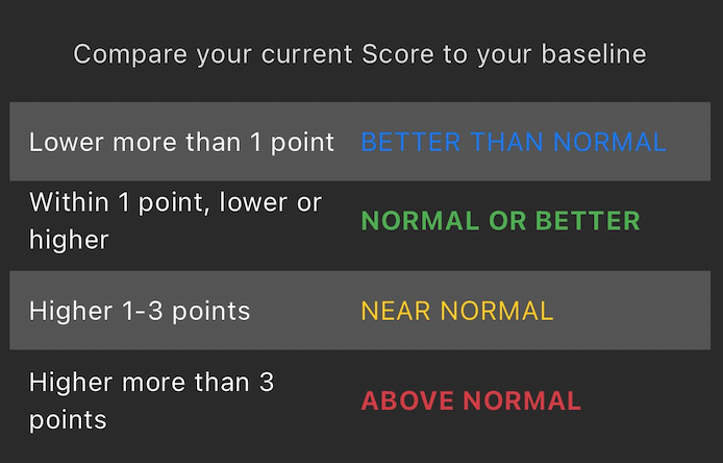
The initial baseline can also serve as a way to assess whether potential or new hires are likely to be capable of performing the tasks of certain jobs. If that job is particularly safety-sensitive and requires a high degree of hand-eye coordination, balance, or decision-making, a potential or new hire’s significantly elevated DRUID baseline may indicate that the individual may be at risk, and may also put co-workers at risk when performing that job.
Because the app’s scores are also correlated against a standard objective measure - Blood Alcohol Concentration (BAC) - the following additional chart, which appears after the app’s score results screen, can help guide employees and employers to make better hiring decisions:
Employers may be amplifying their safety risks by hiring someone to work, for instance, on elevated scaffolding or driving a forklift, who has a significantly elevated initial DRUID baseline score.
21) How can employers impose disciplinary consequences when they don't know the source of the impairment?
No company, of course, wants its employees to come to work impaired, regardless of the cause. Showing up for work impaired by alcohol is considered a “violation” of company policy, subject to disciplinary consequences because it was done knowingly or deliberately, and use of alcohol never has a medical justification. The same is true of drugs. Illicit drugs, medicinally advised cannabis, and many prescription drugs can be impairing. Showing up for work impaired by these drugs is also a violation of company policy.
But it is not necessarily a violation to show up for work impaired from other causes. Impairment caused by fatigue, extreme heat or cold, acute illness, severe stress, and chronic medical conditions (that may be unknown to the individual) are fitness-for-duty problems. These are problems that companies can, for the first time, with Impairment Detection Technologies, including DRUID, address intelligently. A significantly elevated DRUID score alerts the company that the individual requires further evaluation. Such scrutiny may reveal other signs of impairment and perhaps their causes. By taking into account all these indications, the consequences need not be disciplinary but, instead, remedial. DRUID is, thus, an additional objective source of data that employers can add to their existing safety protocols.
22) If a supervisor is negligent and somehow misinterprets DRUID test results, and then the employee causes an accident due to impairment, does the supervisor or the company have any liability?
Generally, the supervisor or company has no liability. The exclusive legal remedy for an employee pursuing a monetary recovery against a supervisor or company for an occupational injury would be limited to the benefits payable under the applicable workers’ compensation laws. This “no-fault” coverage, gives companies and supervisors immunity from being sued for their actions or inactions that resulted in injuries to employees.
There are, however, certain conditions to this exclusive remedy: (1) the relevant actions or inactions must occur within the course and scope of employment and (2) such actions or inactions cannot be intentional or willful. There may be other conditions depending on the laws of the state in which the injury occurred. For instance, some states allow employees to recover more than the workers’ compensation benefit in the event of willful or intentional employer misconduct. However, negligence by the employer or supervisor is not considered willful or intentional misconduct.
Use of DRUID does not subject an employer to any different or greater legal liability than it already has, whatever its current safety policies and practices. In fact, by doing more, by adopting DRUID state-of-the-art safety technology, an employer demonstrates additional safety due diligence, further mitigating any liability risks it might have.
23) If workers receive a bad score, isn't the answer always going to be, “I didn’t sleep well last night”?
An employee’s explanation of an elevated DRUID score should not necessarily be taken at face value. Of course, fatigue from exhaustion or a significant lack of sleep is a legitimate reason for an elevated score and may indicate that the individual’s fitness for duty is questionable. But employers need to check, always, for additional signs of impairment.
This is little different from what employers do now in establishing reasonable cause to test for drugs. They check for changes in the employee’s physical appearance and hygiene, breath odor, speech, gait, emotional responses, irritability, memory problems, or lack of focus. Depending on how elevated the DRUID score is, it may suggest - taken in conjunction with all the other signs - that the individual be sent back to work; perhaps monitored more closely that day or over time; be retested in a couple of hours; be reassigned for some hours, perhaps for the day, to less risky work; be sent home for the day with or without pay; referred to medical care or counseling; or be tested for drug or alcohol use.
24) Have any clients chosen to use DRUID for only high-risk positions/departments?
Yes. Risk on the job presents itself on a continuum from slight to severe with all degrees of risk in between. These circumstances are frequently subject to continual change. In this context, risk is best seen as a “sliding scale” where actions taken to control risk are adjustable. Different levels and kinds of mitigating actions can be applied proportionately to different levels of risk. Critical risks are those that have a reasonable probability of resulting in serious or fatal injury if not managed correctly. Initially, some clients chose to apply DRUID to these critical risk situations and then, when comfortable with its operations, expand usage to other safety-sensitive situations.
25) Are you able to use DRUID with workers who are differently abled e.g., with a prosthetic leg?
Yes, differently-abled workers would be assessed, like anyone else, by comparing their current DRUID score against their baseline. Their performance on all DRUID tests would necessarily be affected by their disability, which would, consequently, be factored into their baseline. In this way, they are being assessed against what is a normal score for them.
As for someone with a prosthetic leg, that person would simply perform DRUID’s balance task twice on the same non-prosthetic leg, rather than once, as the app calls for, on each leg.
26) Can you force a worker to take DRUID?
It depends upon the labor status of the company.
Non-union employers can set any terms for hire that do not discriminate against any individuals protected by federal/state/municipal laws, such as the Americans with Disabilities Act (ADA). Because the DRUID assessment system is NOT a “drug test,” it would not trigger restrictions on pre-employment drug testing (including restrictions specific to cannabis testing). Generally, the use of DRUID with existing employees would also not trigger restrictions.
Where an employer with an existing non-union workforce makes DRUID mandatory, the employee always has the right to refuse the test. Such refusal would then be managed administratively as any other “refusal to test,” be it a drug/alcohol test, medical test, skills test, etc.
If it is a union workforce, any addition of DRUID as a new “term and condition of employment” impacting the portion of the workforce that is organized would have to be negotiated with the union.
For individuals covered by the ADA, “reasonable accommodations” should be reviewed for those who otherwise can perform essential functions of the job but might not be able to complete the DRUID assessment due to conditions such as visual or mobility impairment. Such employees may be able to complete some facets of DRUID or may need to be exempted. Employers can assert a “direct threat to safety” defense if hiring a disabled individual poses an objective hazard to their safety or that of co-workers. On the other hand, DRUID evaluation may be utilized as one of the objective assessment tools that could assist a disabled candidate in demonstrating their ability to meet job-related criteria.
It is important to remember that when used for pre-employment, random, post-accident assessment, or for any other reason, the DRUID evaluation is not a legal substitute for the drug/alcohol testing regimen mandated by the U.S. Department of Transportation for commercial drivers, rail, and aviation workers. For these workers, however, it can be used as an additional layer of screening.
27) Would employers’ use of DRUID give rise to any violation of Employment Practices Liability Insurance?
In any insurance policy, the large print giveth and the fine print taketh away, so a universal answer is impossible. Each policy will have its own language, covenants, and restrictions. At this time, however, we are unaware of any prohibitions on the use of DRUID’s fitness-for-duty assessment under insurance policies – for any purpose, including for hiring purposes, employee assessment during the course of work activities, or when returning to work after a period of absence. On the contrary, because use of DRUID would reduce the number of workers who are unfit for duty for any reason and would lessen the resulting number of compensable injuries and fatalities, this type of assessment should be, and is being, encouraged by insurance.
28) Aside from cost, how would you pitch DRUID as a replacement for the usual testing method, such as sending a worker for a urine drug test?
DRUID is not a replacement for drug testing; it is complementary. The use of DRUID in post-hire testing programs may result in a reduction in the extent and cost of drug testing and the costs associated with impairment at work.
29) If a person is identified by DRUID as impaired, should the company then send that employee for a drug test?
Drug/alcohol testing conducted after a significantly elevated DRUID score is a good option and the DRUID score can support a determination of reasonable suspicion leading to a drug test. It can be more effective in identifying those employees likely to be using drugs than by selecting them for drug testing randomly or periodically. It is a more objective way to identify them than by supervisor observation alone. The combination of a significantly elevated DRUID score together with a positive drug/alcohol test allows for better employee management decisions, defensibility, and risk mitigation.
If the drug test turns out to be negative, the elevated DRUID score remains an unaddressed indication of impairment. At this point, further evaluation and scrutiny of the employee for other signs or causes of impairment would be warranted. The developer of DRUID, Impairment Science, Inc., can assist employers, on demand, in designing a specific program and protocols to further identify and manage non-drug/alcohol impairment.
30) Can DRUID identify whether someone else is taking the DRUID test for them?
Yes, DRUID has anti-cheat options. There are two primary ways to cheat the test. One, to have someone else take the test for you and, two, to cheat on the test’s balance task by standing on two feet or bracing yourself when the app asks you to balance on one leg only.
- Use of a smartphone’s or tablet’s inherent facial ID technology. If an employer elects to utilize this feature, and an employee has someone else take the DRUID test for them, the score will be flagged in the management portal, DRUID Enterprise, as being suspicious for cheating. If desired, DRUID Enterprise will send an alert of such flagging, by email or in-app text, to any designated administrator or supervisor. To confirm or refute a notice of suspected cheating, the employee would be required to re-take the test in the presence of a supervisor, either in person, by Facetime, or other video phone call, where such cheating would be impossible.
- Proprietary algorithms in the app identify each user’s signature pattern of balance. When it detects a movement outside of that pattern the score gets flagged in DRUID Enterprise for suspicion of cheating.
31) Are there potential legal ramifications for sending an employee home, without pay, who exhibits a high score?
We counsel our clients that no disciplinary action regarding an employee should be taken based on a DRUID score alone. DRUID is one of a number of tools that an employer can use to determine fitness for duty. Disciplinary action, such as sending someone home without pay, should be taken based on the totality of indications of impairment. DRUID is meant to filter which company employees, if any, are likely to be impaired and to alert employers that they should evaluate those individuals using the other usual, reasonable means at their disposal.
32) Is there a certification needed to perform the DRUID test?
Certain states require certification to administer drug tests. Because DRUID is not a drug test, no certification is needed to administer it.
33) Do you see any applicability in the era of legal cannabis (medical or recreational) for DRUID with DOT-covered employees?
The DOT requires drug and alcohol testing for employees in aviation, trucking, railroads, mass transit, pipelines, and other transportation industries. DRUID is not approved for use in a DOT program.
Neither the legislation mandating such testing nor the DOT addresses the issue of impairment testing. Indeed, an agency of the DOT, the National Highway Safety Traffic Administration (NHSTA), stated in a 2017 Report to Congress, “Marijuana-Impaired Driving”: … there are currently no evidence-based methods to detect marijuana-impaired driving.”1 The Report goes on to state, “Without a chemical test [for impairment], the alternative is to develop a psychomotor, behavioral or cognitive test that would indicate the degree of driving impairment and elevated risk of crash involvement due to marijuana use. As was described earlier in this report, marijuana has been shown to impair critical driving-related skills including psychomotor abilities like reaction time, tracking ability, and target detection, cognitive skills like judgment, anticipation, and divided attention, and executive functions like route planning and risk-taking… It is certainly possible that when more research has been conducted on the impairing effects of marijuana use on driving, that can be shown to increase the risk of crash involvement, it may be possible to develop such a test in the future.” (emphasis added)
Six years have elapsed since this Report was issued and the future is here now. DRUID is exactly the kind of test anticipated by the Report.
Although the use of DRUID is not part of a DOT testing program, it can be used under company policy and can accompany company drug testing to support fitness for duty. Employers seeking safety beyond the requirements of DOT can take advantage of DRUID to test their workers for impairment due to all the causes of impairment.
FAQs - DRUID OPERATIONAL QUESTIONS
34) Explain how you set a baseline for an employee.
For first-time users, the DRUID app requires and automatically guides them through 3 one-minute practice tests in a row. Once the third test is completed an initial baseline score is established.
35) Does the app keep the baseline score, or does it have to be re-established each time?
No need to re-establish a baseline. It is a continuous rolling calculation, taking into account all your most recent scores.
36) How do you determine if the level or threshold limit is not adequate for a particular job?
Because of the immense range of safety risks posed by different jobs, circumstances, individuals, and environments, each employer must determine the DRUID impairment threshold that it will apply to those risks. DRUID offers guidance regarding the correlation between the level of impairment and the DRUID score. (See, the charts in answer to Question 7.)
37) Do workers have to be proctored for a DRUID test?
No. Earlier versions of DRUID were best utilized in monitored situations. There, one supervisor could successfully proctor groups of up to 30 employees or more at a time. But this meant that unmonitored testing might be subject to cheating.
An anti-cheat version of DRUID is currently available that allows tests to be taken anywhere, anytime. This version flags for suspicion of cheating anyone who has someone else take the test for them and anyone who attempts to cheat on the balance task of the test.
38) Could this test be used to gather baseline data for new hire employees?
Yes, a good use of DRUID is for testing potential hires or after making a conditional offer of employment. If the job specifically requires particularly good balance, hand-eye coordination, mental concentration, or decision-making to be fit for duty, then filtering out those candidates with very high DRUID baseline scores helps minimize safety risk. You don’t want a new hire to perform a safety-sensitive job that they are likely to be unable to do, putting them and their co-workers at risk.
39) What about performing DRUID’s one-leg stand? Wouldn’t wearing flip-flops cause an unbalance?
Wearing flip-flops, other unstable footwear, or testing in bare feet, might promote a slight imbalance for some people. Whatever the footwear, if an employee wore the same footwear every time the test was taken, whatever imbalance the footwear might cause would be factored into that person’s DRUID baseline score. That is, a current DRUID score of someone wearing flip-flops when compared against his baseline, where all or most of the scores that make up that baseline were taken wearing flip-flops, would be comparing apples to apples. If that person were suddenly to switch to a stable shoe or sneaker, it is possible that their current score would be slightly lower, a decrease not likely to be relevant for impairment assessment purposes
Nonetheless, DRUID recommends that the test be generally taken under similar circumstances and that stable shoes be worn. Many DRUID users are keen to keep their score low, or to lower their score, by improving their balance. Wearing stable shoes will optimize their performance.
40) What is the cost for DRUID?
Please contact Impairment Science directly. DRUID list pricing starts is discounted depending on the number of employees being tested and the frequency of testing.
While in many cases it makes sense to test every employee in a safety-sensitive position, not all positions are equally safety-sensitive. How many employees should be tested with DRUID, and how often, is likely to be dependent on the nature of the jobs, the particular culture of safety in each company, and the company’s available resources.
41) Will subscription costs be affected by the amount of data storage?
Data storage costs are built into the list price.
42) Could DRUID also give a warning if someone's glucose is high/low?
No, but the results of a glucose test, or any other test, data, or comment, can be entered into DRUID’s “Note” feature, which appears before and after each test. Data so entered is also accessible in DRUID Enterprise’s database along with the DRUID test results.
FAQs - OTHER IMPAIRMENT DETECTION TECHNOLOGIES ^
43) Is it true that cannabis impairment lasts 1-3 hours?
The duration of cannabis impairment is still under investigation and the data from existing published studies varies. Generally, it depends on several variables: (1) the size of the dose; (2) the potency of the cannabis variety; (3) whether it is inhaled or taken orally; (4) whether the individual uses cannabis frequently, occasionally, or not at all; (5) the definition of impairment. At a minimum, significant impairing effects for inhaled cannabis can last up to 3 hours and for cannabis taken orally, according to some studies, as long as 10 hours.
44) Can breathalyzers detect THC, the psychoactive ingredient of cannabis, from edibles or oral modes rather than smoking?
Breathalyzers to detect THC are just entering the market and published data is very limited. To date, there are no studies available indicating that THC from edibles can be detected using a breathalyzer.
45) Is there a test that can detect if someone is impaired from THC?
Yes, DRUID. In clinical studies, DRUID is the only digital test that has been proven by science to detect and measure the degree of THC impairment. In the field, if someone is materially impaired from THC and is tested with DRUID, the test will score as impaired. But because DRUID is a general test, detecting all other causes of impairment, the score will not identify the specific cause.
46) What about the mouth swab test?
Oral fluid tests test for drugs only. A positive drug test, however, does not necessarily indicate whether that person is impaired, only that the drugs tested were found to be in the sample at or above the cut-off level in the test panel.
47) When will a direct test, as we have for detecting impairment by measuring blood alcohol concentration (BAC), be developed for detecting impairment by measuring the bodily presence of THC?
Despite a great deal of time, effort, and money invested, there is currently no commercially available test for cannabis impairment that works by measuring the bodily presence of THC. THC breathalyzers do measure the bodily presence of THC, but they do not measure the impairment caused by THC. No such test appears to be on the near-term development horizon.
That said, in clinical studies, DRUID is the only commercial test that has been demonstrated to detect and measure cannabis impairment. In the field, where conditions vary widely, DRUID will identify impairment if it is caused by cannabis, but because DRUID is a general test for impairment, it does not identify the specific cause of the impairment.